
Loading ...
Cover Photo By Reggan Dumpert
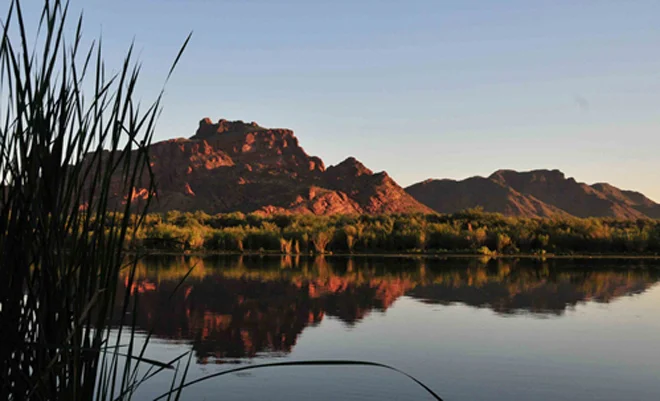
This proposed site of the Orme Dam would have flooded miles of critical riparian habitat on the Salt and Verde Rivers. Today, it is home to desert-nesting Bald Eagles and hundreds of other species of birds, mammals, fish, reptiles, amphibians, arthropods, and plants that depend on this endangered riverine ecosystem. Maricopa Audubon was instrumental in stopping the dam project. In the background is Red (Sawik) Mountain, on lands of the Fort McDowell Yavapai Nation and the Salt River Pima-Maricopa Indian Community.
Trespassing horses and cattle moving into riparian areas is a major problem statewide. Recently, there has been some limited success in getting federal land managers to remove some of them.
In February, The Forest Service authorized and implemented the aerial shooting of feral cattle in New Mexico’s Gila Wilderness. In a press release prior to their removal the Forest Service acknowledged the damage the cattle were doing in riparian areas. The operation succeeded in removing 18 feral cows.
Last fall approximately 215 horses were removed by the Forest Service from the Apache Sitgreaves National Forest which has been overrun by feral horses. Their removal came about as a result of an earlier court settlement, to which Maricopa Audubon Society was a party, that implemented policies and procedures to protect and conserve critical riparian habitat of the New Mexico Meadow Jumping Mouse. Current estimates put the feral horse population on the Apache Sitgreaves at 1500. The 215 horses that were removed, is just keeping up with their reproductive rate.
The San Pedro Riparian National Conservation Area ((SPRNCA) continues to be invaded by trespassing cattle. Since the court settlement in August 2022, to which MAS was also a party, there have been over 60 documented and reported instances of trespassing cattle in critical habitat of several threatened and endangered species including the Huachuca Water Umbel, Western Yellow-billed Cuckoo and Northern Mexican Garter Snake. Maricopa Audubon Society, along with other organizations, have filed a formal protest of the BLM’s recent decision to allow grazing on 4 allotments partially located within SPRNCA. Maricopa Audubon Society has also filed a supplemental notice of intent to sue the Bureau of Land Management over their failure to conserve and recover endangered species within SPRNCA who’s continued existence is being jeopardized by trespassing cattle.

On February 1-3, 2022 MAS volunteers joined two field biologists to survey thrasher populations near the Thrasher Spot west of Phoenix. Teams of three, a field biologist and two volunteers, spent the mornings spread out and moving through the desert terrain to see (or often hear) the thrashers.
MAS members will remember that First Solar Corporation proposes to build a solar farm on 3200 acres of mostly State Trust Land that include the Thrasher Spot at Baseline and the Salome Road. Four species of Thrashers can be found there, and Bendire’s and LeConte’s Thrashers nest in the area. Birders come from across the country to get their first LeConte’s Thrasher here.
Maricopa County Planning and Zoning approved the changes in zoning necessary for the solar project to proceed last summer. Construction of the solar farm has not begun, and the February 1-3 survey revealed that thrashers still inhabit the area. All four species were seen, although the mix shifted from the similar survey MAS conducted in 2021. In 2021, Bendire’s Thrashers significantly outnumbered LeConte’s; this year’s survey found roughly similar numbers of both. Sage and Crissal Thrashers were also seen, though in smaller numbers.
The 2021 and 2022 surveys will be used to furnish the “Before” data in a Before and After assessment completed after the solar farm is up and running. MAS has requested information from the State Land Department concerning their negotiations to lease or sell the tract, but has not yet heard back.
Video of LeConte’s Thrashers from the Thrasher Spot surveys:
This proposed block cave copper mine threatens camping, climbing and recreation sites near Superior. The mine would collapse the land under Oak Flat, sacred to the San Carlos Apaches, and leave a permanent crater,1000 feet deep and about two miles wide.
The mining company plans to move more than a billion tons of waste rock and tailings from the site to a valley miles away, building a sixty story dam to keep the waste from flooding the Gila River. Mining on this scale would require new sources of water in an area already suffering from the loss of its streams, rivers and groundwater.
Special-interest legislation requires the Forest Service to transfer Oak Flat to Resolution Copper 60 days after a final environmental impact statement (EIS) is released, regardless of what the EIS says about the harm the mine would cause. As recently as January, it appeared that Resolution Copper would own Oak Flat by March, 2021. A last-minute reprieve resulted when the U.S. Forest Service withdrew the EIS and promised to redo it.
With allies such as the Arizona Mining Reform Coalition and the San Carlos Apache Tribe, MAS has fought to derail plans for the mine through litigation, testimony at public hearings and public education.
“We are thrilled to participate in the Lights Out program. Turning off non-essential lighting during the bird’s migratory season not only saves us electricity, but we provide a safer passage for night-migrating birds. It’s a win-win for all!”
– Yesenia Felix, Vice President, Operations | Cousins Properties
Turning off lights and other light-reducing actions can:
cut your spending on energy costs,
increase your well-being,
tackle extreme temperatures in Arizona
save birds.
An APS case study of a Phoenix car dealership found that delamping (i.e. removing unnecessary bulbs and fixtures) resulted in thousands of dollars of savings in energy and maintenance costs. What does lighting have to do with birds? Lighting attracts birds as they migrate, often causing fatal collisions. A study found that by reducing lighting by just half in a commercial waterfront property in Chicago, bird deaths could be reduced by 60% (Doren et al. 2021). From 2021-2023, Audubon chapters in Maricopa County surveyed buildings and found many bird strikes and deaths. As the county and its economy grows, it is imperative that businesses take action to prevent unnecessary deaths.
A study of bird-building collisions found that 44% of all bird-and-glass collisions — about 253 million bird deaths annually — occur at residences (Loss et al. 2014). There are simple actions that can be done at home on the exterior of glass windows to reduce bird strikes, including installing insect screens, hanging cords, and/or using patterned dots stickers (we recommend Feather Friendly products).
Peak migration for Phoenix is April 17 – May 12. Millions of birds are migrating and are susceptible to being distracted by lights, then colliding into buildings. Track spring and fall migration at Birdcast: https://birdcast.info
You can stop this from happening by turning off your lights by 10pm!
2024, March – Maricopa Audubon Society & Desert Rivers Audubon Society join the major wave of Lights Out efforts sweeping the nation – “[Bird] deaths are preventable, and thankfully momentum is growing to reduce bird-building collisions in cities and states across the country. … Audubon’s efforts continue to grow, with more than 50 cities and regions involved in Lights Out Programs, encompassing many of the most dangerous metropolitan areas for migratory birds. The work of chapters and other local groups has been crucial.” NAS article
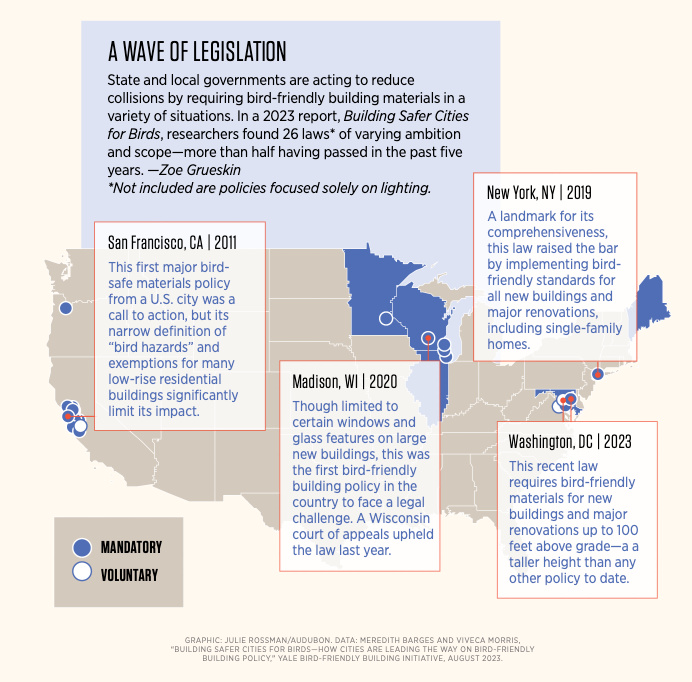
2024, February – The death of a beloved owl, Flaco, has garnered much attention in the news
“Flaco, an Eurasian Eagle-Owl, first gained fame when he escaped the Central Park Zoo after an act of vandalism of his enclosure over a year ago. His presence in Central Park drew bird lovers from New York City and beyond eager to catch a glimpse of an enigmatic — and very large — owl. Flaco captured the imaginations of people around the world and brought birds close to home for New Yorkers. Now, millions who were captivated by Flaco are mourning his loss after he died over the weekend, the result of a collision with a building.” — Article by ABC
Wanna help? Support the FLACO Act
